
leak detection
Acoustic Leak Detection vs. Traditional Methods in Fine Homes: A Guide
A hidden leak behind plaster, under a slab, or inside a custom millwork wall does not announce itself. In an architecturally significant home, the first question is never just where the water is. It is how to find it without destroying finishes that cannot be replaced from a catalog. Acoustic leak detection answers that question differently than the traditional methods most plumbers reach for, and for anyone managing a high-value home on the Westside, the difference matters. This guide compares acoustic leak detection with older approaches, explains when each one earns its place, and reframes the whole subject as what it should be: preventive estate care, not a reactive plumbing visit.
Why Leak Detection Is Estate Care, Not Emergency Plumbing
For an estate manager, a leak is rarely a plumbing problem. It is a finishes problem, a structure problem, and, if the house holds a collection, an art problem. Water that travels along a joist for eight feet before it shows at a ceiling can reach Venetian plaster, white oak flooring, a suspended installation, or the climate stability of a private gallery long before anyone sees a stain.
The scale of the risk is documented. According to the U.S. Environmental Protection Agency, ten percent of U.S. homes have leaks severe enough to waste 90 gallons or more of water per day, and the average household's plumbing leaks can waste more than 10,000 gallons of water every year. In an ordinary house, that is a utility bill. In a home built to the architect's drawings, it is slow structural damage hidden behind work that took craftsmen months to complete.
Therefore the real decision is not whether to investigate a suspected leak. It is how to investigate it in a way that protects the owner's property and keeps the household calm. That is where the choice of detection method becomes a judgment call rather than a default.
Signs of a Hidden Water Leak Worth Acting On
Most hidden leaks give notice before they give trouble. The signs are small, and they are easy to dismiss in a large house where one person cannot walk every room every day. The ones worth acting on:
- A water bill that climbs with no change in household use
- The sound of running water when every fixture is off
- Warm spots on a floor, often the first sign of a slab leak on the hot water line
- Hairline cracks in plaster or a faint cupping in hardwood near a wall
- A musty smell in a closet, cabinet base, or mechanical room
- The water meter dial moving with all valves closed
Any one of these justifies a call. In addition, moisture damage in older homes deserves a lower threshold. Galvanized supply lines, original cast iron drains, and pre-war waterproofing details fail gradually, and a home from the 1930s or 1950s has had decades for small intrusions to compound inside walls no one has opened since construction.
How Traditional Leak Detection Methods Work
Traditional leak detection means finding the water by following the damage. For decades that meant a process of elimination: isolate sections of pipe, pressure-test them, and then open walls, floors, or slabs at the most likely point. It works, and it still has a place, but it trades the owner's finishes for information.
Exploratory demolition
The oldest method is the saw. A plumber cuts an access hole where the stain appears, looks, cuts again where the pipe runs, and keeps going until the leak shows itself. In a production house with painted drywall, the patching is routine. In a home with integral color plaster, book-matched paneling, or hand-set tile, every exploratory hole is a restoration project. One missed guess can turn a two-hour repair into a six-week finishes job.
Pressure testing and isolation
Pressure testing confirms that a leak exists and narrows it to a zone. The plumber caps sections of the system, charges them with air or water, and watches the gauge. This is reliable for answering whether a line leaks. However, it cannot say where along a sixty-foot run under a slab the failure sits. It narrows the search; it does not end it.
Dye testing and visual tracing
For drains, shower pans, and roof penetrations, dye testing remains useful. Colored dye in a suspected fixture shows up where the water exits. It is simple and non-destructive, but it only works where the water's path eventually becomes visible, which is exactly what hidden leaks avoid doing.
Thermal imaging
Infrared cameras read surface temperature, not moisture. A wet patch of drywall cools by evaporation, so it often shows as a shadow on the camera. Thermal imaging is a strong screening tool, and it pairs well with moisture meters. The limitation is that it sees symptoms, not sources. It can show where water has arrived, not always where it left the pipe, and dense materials like concrete mask the signal.
How Acoustic Leak Detection Works
Acoustic leak detection locates a leak by sound rather than by damage. Water escaping a pressurized pipe produces a distinct noise, a hiss or rush at the breach point, plus vibration that travels along the pipe itself. A trained technician uses a ground microphone and amplifier tuned to those frequencies to listen through slabs, soil, and finished walls.
The process is methodical. First, the technician confirms the leak with the meter and isolates the likely line. Next, ground sensors move along the pipe's path in a grid, and the amplified signal grows louder as the sensor approaches the breach. Modern listening equipment filters out ambient noise, traffic, pool pumps, and HVAC, so the reading isolates the leak's signature. Some firms add a correlator that compares the sound's arrival time at two sensors and calculates the breach position between them, often within a foot or two.
The result is a mark on the floor, not a field of exploratory holes. For slab leak detection in particular, this precision is the difference between opening one 18-inch square of concrete and trenching a hallway. On a hot water line under a limestone floor, that precision protects material that may no longer be quarried.
Where methods using sound detection reach their limits
No method is universal, and an honest comparison says so. Listening for a leak depends on pressure; it excels on supply lines and performs poorly on gravity drains, where escaping water makes little sound. Deep burial, soft soil, and PEX or other plastic piping dampen the signal, since plastic carries vibration less efficiently than copper or steel. A noisy site can mask a small leak. In those cases a careful practitioner combines methods: tracer gas for quiet plastic lines, camera inspection for drains, thermal imaging for radiant floor systems. The skill is in choosing the sequence, which is why the technician matters more than the instrument.
Comparing the Methods for an Architecturally Significant Home
For a standard tract house, the comparison between methods is mostly about cost and speed. For a fine home, the weighting changes. The right question is not which method finds leaks, since they all can. It is which method finds this leak with the least harm to the house around it.
Consider the trade-offs side by side:
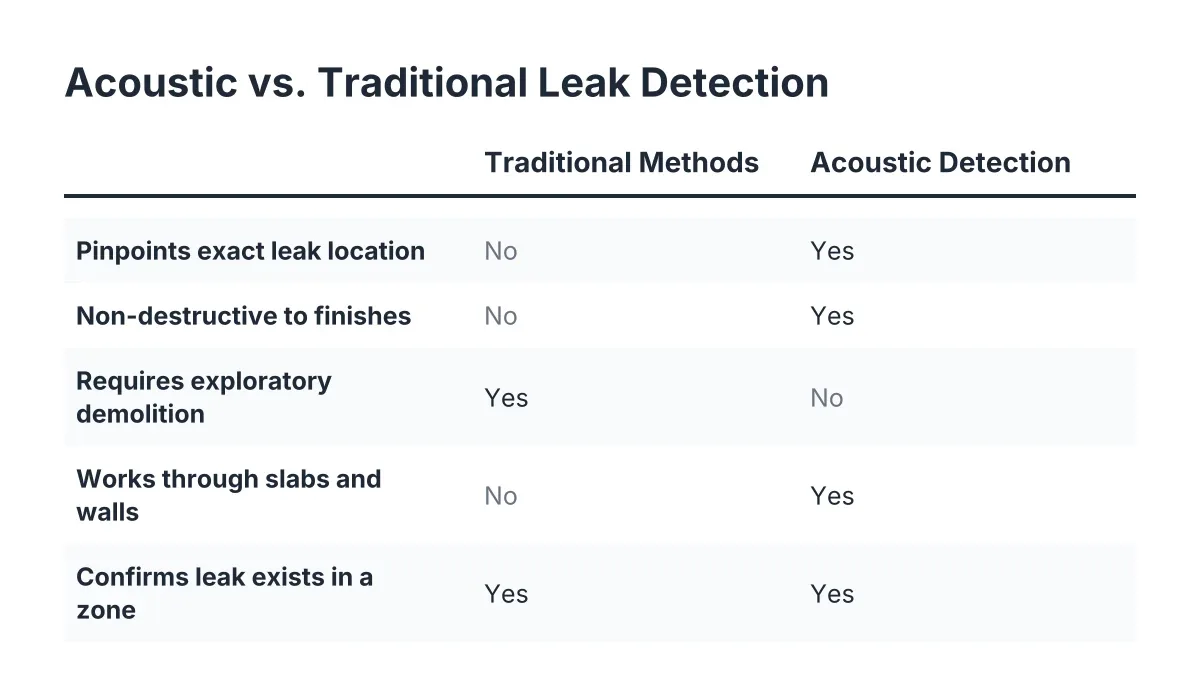
- Precision. Acoustic correlation typically locates a pressurized leak within one to two feet. Pressure testing narrows it to a zone. Exploratory demolition is only as precise as the last hole cut.
- Damage to finishes. Acoustic and thermal methods are non-invasive. Dye testing is non-invasive for drains. Demolition is, by definition, destructive, and in a custom home the destruction lands on irreplaceable work.
- Pipe material and location. Acoustic methods favor metal supply lines under slabs and behind walls. Drains, plastic lines, and roof intrusions call for cameras, tracer gas, or dye.
- What the finding supports. A precise acoustic locate supports a surgical repair. A vague zone supports a reroute or a larger opening, which sometimes is still the right engineering answer on a failing line.
That last point deserves emphasis. On an aging galvanized or thin-wall copper system, locating one pinhole precisely does not change the fact that the whole run is near the end of its life. The correct response may be a planned repipe during a renovation rather than a sequence of pinpoint repairs. A contractor who only sells detection will not say that; a contractor responsible for the whole house should.
A Hypothetical Week in an Estate Manager's Life
Suppose an estate manager on the Westside notices the water bill for a 1950s hillside home has climbed for two consecutive months. Nothing is visibly wet. A general plumber proposes opening the terrazzo hallway floor at three points to trace the hot line, since the slab runs are original copper. Each opening means cutting terrazzo that was poured in place and cannot be color-matched from stock.
In that scenario, an acoustic survey changes the sequence entirely. A technician confirms flow at the meter, isolates the hot side, and walks the slab with ground sensors. The correlator places the breach under a hall closet, off the terrazzo field. The repair opens one small section of concrete beneath carpet, the line is sleeved and repaired, and the terrazzo never meets a saw. Additionally, the finding also prompts a conversation with the owner's architect about rerouting the remaining slab runs overhead during a planned kitchen renovation, so the next pinhole never happens under that floor.
Measured against re-fabricating historic flooring, the cost of a professional acoustic locate is not the number worth worrying about. The number worth worrying about is the one that accrues while a leak runs unfound.
Proactive Monitoring: Catching the Leak Before the Search
The strongest comparison is not acoustic versus traditional. It is detection versus monitoring. Every method discussed so far starts after a leak exists. Proactive leak monitoring starts before, and for a household that expects problems solved quietly, it is the standard worth adopting in 2026.
The evidence for prevention is unusually clear. A 2020 loss correlation study of 2,306 homes by LexisNexis Risk Solutions found that installing an in-line water shutoff device correlated with a 96% reduction in escape-of-water insurance claim events. These systems watch flow continuously, learn the household's normal patterns, and close the main automatically when flow looks like a failure instead of a faucet. Several insurers that write high-value Westside homes now ask about them at renewal.
For a large property, a sound monitoring posture layers three things:
- An in-line flow monitor and automatic shutoff on the main supply
- Point sensors at the quiet failure sites: water heaters, laundry, refrigerator lines, mechanical rooms, and below-grade galleries
- A scheduled walk-through by someone who knows the house, reading meters, checking crawl spaces, and looking at the roof before the rainy season rather than during it
This is the logic behind treating leak detection as part of estate management rather than as an emergency trade. When the house is watched continuously, the acoustic survey becomes a precision tool used occasionally, not a scramble that begins after a ceiling stains. For a firm like Dick Minium Construction, which builds and renovates architecturally significant homes and then keeps them through ongoing estate management, detection, monitoring, and repair sit inside one workshop. Build, Install, and Keep share the same drawings, so the person listening through the slab already knows what the architect put in it.
Choosing Who Does the Work
Searching for leak detection near me, or a water leak detection company near me, returns two kinds of firms. The first owns instruments and finds leaks; the work ends at the mark on the floor. The second takes responsibility for what comes after: the water intrusion repair, the dry rot behind it, the plaster, the flooring, and the question of whether the system should be rerouted rather than patched.
For a standard home, the first kind is often enough. For a home where the finishes are the point, the second kind prevents the familiar failure mode every estate manager knows: five trades on site, each responsible for one layer, each pointing at the others when the ceiling is open and no one owns the whole. A single contractor who can locate the leak, open the wall, repair the line, treat the dry rot, and restore the finish to the architect's intent removes that gap. One call, one point of accountability, one standard for the finished surface.
Questions worth asking before anyone listens to a wall:
- What locating methods do you carry besides acoustic, and how do you choose between them?
- Who performs the repair and the finish restoration, and is it the same firm?
- Have you worked in homes with original plaster, stone, or custom millwork?
- Will you document pipe routes and findings so the house's record grows with each visit?
- Can you install and maintain flow monitoring, not just respond to failures?
One caution belongs here. Interpreting acoustic readings takes trained judgment, and a misread signal on a complex slab can send a saw to the wrong place. If a reading is ambiguous, or if the leak sits in a drain, a roof assembly, or below-grade waterproofing, bring in a professional who can combine methods rather than forcing a single instrument to answer every question.
The Short Version
Acoustic leak detection finds pressurized leaks by sound, locates them within a foot or two, and spares the finishes that make a fine home what it is. Traditional methods, from pressure isolation to exploratory demolition, still answer certain questions, especially on drains and failing systems where a precise point matters less than an engineering decision. The strongest position for a high-value home is to need the search rarely: monitor flow continuously, shut off automatically, walk the house on a schedule, and keep one contractor accountable from the first sound through the last coat of plaster. For an estate manager, that is the difference between managing an emergency and reporting, quietly, that one never happened.
If this is the work you are planning, Dick Minium Construction is one call away: 310.392.6622.
Prefer to talk it through? Call (310) 392-6622 — a quick call is usually the fastest way to get a straight answer for your situation.