
custom art installation
What a Residential Art Installation Asks of the House: Engineering, Materials, Labor
A nine-foot bronze arrives at the gate on a flatbed. The owner is traveling. The art advisor assumes the house is ready for it. Additionally, the estate manager, who found out about the piece two weeks ago, is now asking the question nobody else has asked: who is actually responsible for getting this thing inside, mounted, lit, and protected, and what will it cost to do it right? Residential art installation sits in a gap between trades. Framers hang pictures. Galleries pack crates. General contractors pour slabs. The work in between, the engineering that lets a home carry serious art safely, is where the real cost lives, and it is the part almost nobody prices honestly up front. This guide explains what that work includes, where the money goes, and how to judge whether a contractor can do it.
Why Art Installation in a Home Costs More Than Hanging
Most of the cost of residential art installation is not the hanging. It is the structure, lighting, and environmental work that has to exist before the piece touches the wall or floor. A home was engineered to hold people, furniture, and a roof, not a 1,400-pound steel sculpture on a cantilevered landing or 600 pounds of blown glass suspended from a ceiling.
An art hanging service will quote you an hourly crew rate to place framed work. That number is real, and for prints and paintings under 50 pounds it is most of the story. For everything else, it is the smallest line on the invoice.
Consider what has to be true before a heavy piece is safe in a residence. The floor or wall must carry the load, not just today but through a seismic event. The anchor points must tie into structure, not drywall. Furthermore, the light must render the work as the artist intended without cooking it. Notably, the room must hold temperature and humidity within a range the material tolerates. Each of those is a trade, and each one has a cost.
This is why the useful question is not "what does installation cost per hour" but "what does this piece require from the house." The answer determines whether you are writing a four-figure check or managing a four-month structural project.
The Three Cost Layers of a Residential Art Installation
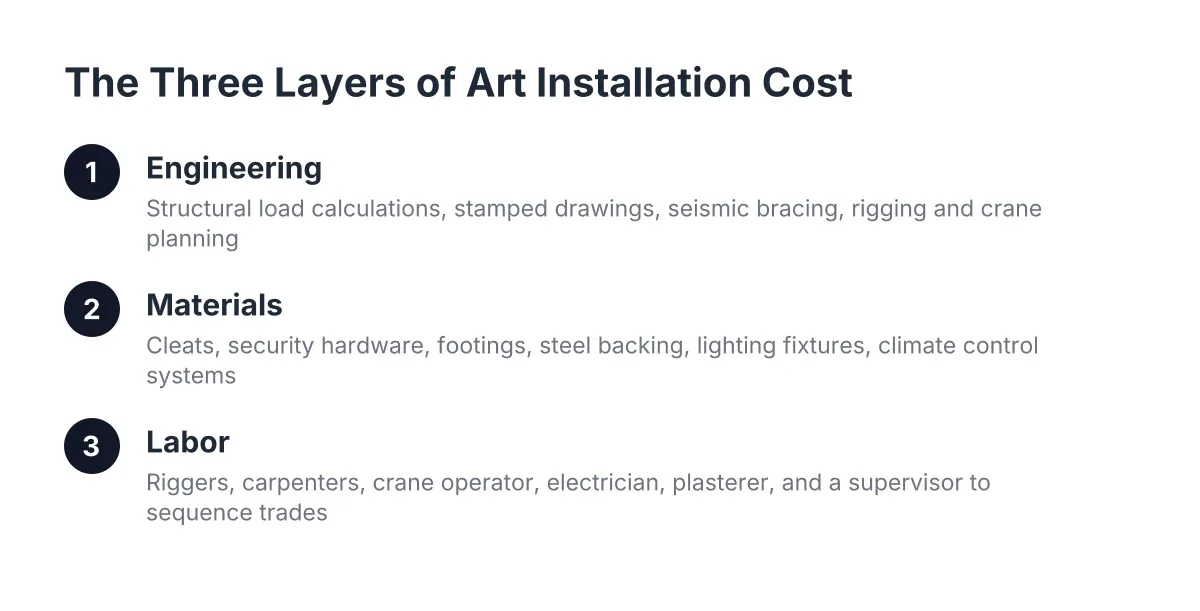
Every installation budget breaks into the same three layers: engineering, materials, and labor. Understanding how each layer scales with the piece lets an estate manager read a proposal intelligently instead of comparing bottom lines that describe different scopes.
Engineering: the cost that is invisible when it is done well
Engineering is the layer most quotes omit and most failures trace back to. For anything heavy, suspended, or seismic-sensitive, a structural engineer has to calculate loads, specify anchors, and in many cases produce stamped drawings for the building department.
The cost drivers here are weight, suspension, and location. A floor-standing sculpture over a few hundred pounds may need the framing below it evaluated, blocking added, or a concrete pad poured. Suspended work is its own category; a ceiling-hung glass installation needs attachment points engineered into joists or steel above the finish ceiling, with load paths traced down to the foundation. In Los Angeles, seismic loading governs the design, which means lateral forces, not just the static weight, size the connections.
A sculpture installation contractor who has done this work will also think about the path, not just the destination. Can the piece pass through the door, the stair, the garden gate? Does it need a crane over the roof, and does the crane need a street permit and a traffic plan? Rigging engineering for a single crane day on a Westside hillside lot can cost more than the mounting hardware for the entire piece. None of that appears on a framing studio's rate card.
Materials: hardware, surfaces, and the systems behind the wall
The materials layer covers everything bought for the installation itself. It ranges from stainless cleats and museum-grade security hardware to poured footings, steel backing plates, plinths, and pedestal fabrication. For suspended work, it includes aircraft cable or rod systems rated well beyond the piece's weight, plus the concealed steel that carries them.
Lighting hardware is usually the largest materials line after structure. Proper art lighting design means fixtures with high color rendering, UV filtration where the medium demands it, adjustable beam spreads, and dimming that does not flicker on camera. Running new circuits, recessing fixtures into a finished plaster ceiling, and patching that ceiling invisibly is construction work, and it is priced as construction work.
Climate control for art collections sits in this layer too. Works on paper, photographs, and some paintings want stable humidity; a room that swings with the marine layer and the afternoon sun will damage them slowly and invisibly. Adding humidity control, UV-filtering glazing on a window wall, or a dedicated HVAC zone for a private gallery is a mechanical project with its own permits and its own budget line.
Labor: the crew, the trades, and the sequence
Labor is the layer people expect, and it is still routinely underestimated. A straightforward day placing framed work takes a two-person crew. A heavy sculpture installation takes riggers, carpenters, sometimes a crane operator, an electrician for the lighting, a plasterer or painter for the repairs, and a supervisor who sequences all of them so the finish work is not destroyed by the heavy work.
Sequence is where cost hides. Suppose an estate manager in Brentwood inherits a commitment the previous manager made: a commissioned suspended piece, about 500 pounds of glass and steel, going into a double-height stair hall in a finished, occupied house. In that scenario, the structural attachment points should have been engineered and framed during the last renovation. Because they were not, the crew now opens a finished ceiling, adds steel between joists, closes it, matches the plaster, repaints, and only then rigs the piece. As an illustrative estimate, the retrofit work can run three to five times what the same structure would have cost built into the drawings originally. The glass did not get more expensive. The sequence did.
Site protection is labor too. Floors covered, stone wrapped, art already in the house shielded, the crew working clean in a home the family is living in. On an architecturally significant home, protection and restoration of the surrounding finishes is a real percentage of the job, not an afterthought.
What a Complete Installation Scope Includes
When a proposal for a custom art installation is complete, it reads like a small construction project, because it is one. Before signing anything, check that the scope covers each of the following, and treat anything missing as a cost you will absorb later:
- Structural evaluation and, where required, stamped engineering for the load
- Mounting or suspension hardware specified for the piece, including seismic restraint
- Rigging plan, equipment, and any crane or street permits
- Electrical work and fixtures for art lighting, with circuits and dimming specified
- Environmental measures where the medium requires them, from UV filtration to humidity control
- Protection of existing finishes and restoration of any surfaces opened for the work
- Permits and inspections where structural or electrical work triggers them
- Coordination with the artist's studio, the gallery, the conservator, and the owner's architect
Items that are usually extra, and should be flagged as such in writing: crating and transport to the site, conservation or condition reporting, custom pedestal or vitrine fabrication, and any landscape or hardscape work for exterior pieces, such as footings, drainage, and night lighting in the garden.
On timing, be skeptical of anyone who promises a date before the engineering is done. Simple hanging work is measured in days. Projects involving structural work, permits, or fabrication are measured in months, and the honest answer at the first meeting is a sequence, not a date.
When the Household Can Handle It, and When to Call a Contractor
A household crew or a competent framer can safely handle framed work under about 50 pounds on standard interior walls, with proper anchors into studs. That is the reasonable boundary of in-house work, and staying inside it saves money with no real risk.
However, certain conditions move the job to a licensed contractor regardless of how confident the crew feels:
- Any piece heavy enough that its failure would injure someone or destroy the floor below it
- Anything suspended from a ceiling, at any weight
- Mounting into stone, tile, plaster over masonry, or any irreplaceable finish
- Exterior sculpture, which needs footings, drainage, and wind and seismic loading addressed
- New lighting circuits, or any fixture recessed into a finished ceiling
- Installations in rooms with humidity-sensitive media and no climate control
There are also warning signs that mean call now rather than at the next convenient moment: a previously hung heavy piece that has shifted or tilted, hairline cracks radiating from an anchor point, or a suspended work that moves audibly in wind or during minor seismic activity. Each of those is a load path announcing a problem.
One honest limitation: a general contractor is not a conservator. Condition assessment, surface treatment, and restoration of the artwork itself belong to a conservation professional, and a good contractor will say so and coordinate with one rather than touch the work.
Westside Los Angeles Factors That Move the Budget
Local conditions change installation costs in ways a national guide will not mention. On the Westside, three factors come up on nearly every substantial project in 2026.
First, seismic design governs everything heavy or hanging. Los Angeles building requirements mean suspended and top-heavy installations are engineered for lateral forces, and anchors that would pass in a calmer region will not pass here. This adds engineering and hardware cost, and it is not optional.
Second, access is a genuine line item. Hillside lots in Pacific Palisades or Bel Air, narrow canyon streets, and gated drives often rule out a truck-and-dolly delivery. Crane days, street-use permits, and neighbor coordination belong in the budget from the start, not as a surprise the week of delivery.
Third, the marine environment works on art and on structure. Salt air corrodes exterior mounting hardware, which argues for stainless or duplex steel on coastal pieces. Indoors, humidity that tracks the marine layer makes climate control for works on paper a Westside question, not just a museum question. The same moisture attacks the house itself; a slow envelope leak near an art wall threatens the collection before anyone sees a stain. According to the U.S. Environmental Protection Agency, ten percent of U.S. homes have leaks severe enough to waste 90 gallons or more of water per day, and a home holding serious art cannot be one of them.
All of this sits inside a busy market. Harvard's Joint Center for Housing Studies projects annual home renovation and repair spending to reach $519 billion through mid-2027, which means engineers, riggers, and skilled finish trades are booked. Lead time is a cost factor too; the earlier the installation enters the drawings, the less it competes with everyone else's schedule.
How to Choose a Residential Art Installation Contractor
Choose a residential art installation contractor the way you would choose a structural trade, not a delivery service. The right firm has a license, carries insurance sized for the value of the work and the home, and can show completed installations of comparable weight and complexity. For custom art installation in Los Angeles, that record should include seismic engineering, crane work, and finished homes where the installation is invisible except for the art itself.
Three questions separate the qualified firms from the hopeful ones:
- Who does your structural engineering, and will the calculations and drawings for this piece be stamped? A firm that engineers in-house or has a standing relationship with a licensed structural engineer will answer in one sentence. A firm that hesitates is planning to guess.
- Walk me through your last suspended or over-500-pound installation. You are listening for specifics: the attachment detail, the rigging plan, how the finishes were protected and restored, who else was on site. Vague answers mean the experience is thinner than the website suggests.
- How do you work inside an occupied home? For an estate manager, this is the question that matters daily. Discretion, a clean site, named crew members, and one point of contact are not courtesies; they are scope.
A fair proposal itemizes the three layers this article describes. Engineering is listed with the engineer named. Materials are specified, down to the fixture model and the anchor type. Labor shows the trades and the sequence. A single lump number with the word "installation" next to it is not a lower price; it is an undefined scope, and undefined scope always costs more in a home that cannot absorb mistakes.
There is a final consideration that matters more over time than any single project. Art in a home is not installed once and forgotten. Fixtures drift and need re-aiming, hardware should be inspected after seismic events, humidity systems need monitoring, and the envelope around the collection needs to stay tight. A contractor who built or renovated the house, engineered, hung, and lit the work, and then keeps the house in readiness afterward gives the household something a one-visit installer cannot: continuity. When the house is watched by the people who know where every anchor and circuit lives, problems surface as line items instead of emergencies, and the owner never has to think about any of it.
For owners, architects, and estate managers on the Westside weighing an installation, a conversation about the specific piece, the specific room, and the engineering between them is the right first step. Dick Minium Construction can be reached at 310.392.6622 to discuss the work and prepare an estimate built to the actual scope.
If this is the work you are planning, Dick Minium Construction is one call away: 310.392.6622.
Prefer to talk it through? Call (310) 392-6622 — a quick call is usually the fastest way to get a straight answer for your situation.